


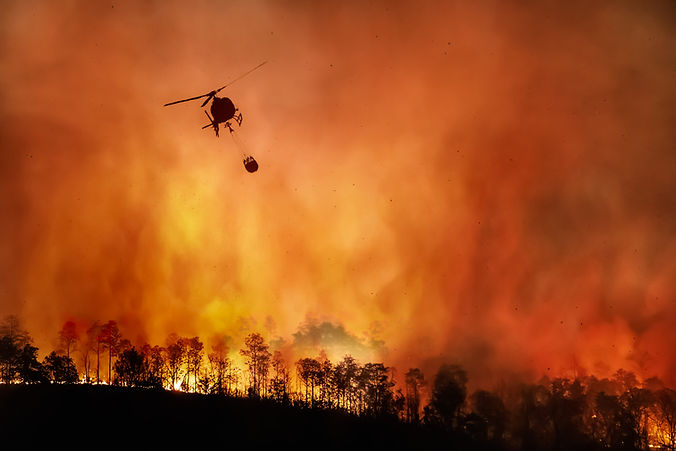
Wildfire model
Our wildfire model leverages advanced AI and a wide range of environmental and human factors to map wildfire susceptibility across Canada. Providing high-resolution, property-level insights, it empowers insurers and financial institutions to better assess risk, strengthen underwriting and pricing, and protect portfolios while safeguarding communities and assets.
Characteristics of Our Model
Science-Driven
Model
Powered by artificial intelligence, the wildfire model is built on the analysis of 77 variables covering climate, vegetation, topography, and human factors.
This combination of data captures the complexity of wildfire dynamics and provides a detailed, scientifically robust understanding of risk.
High spatial
resolution
The wildfire model generates continuous risk scores at the property level, offering a more precise view than traditional zoning.
Available across Canada, it provides insurers, financial institutions, and asset managers with a reliable tool to better anticipate potential losses, refine pricing, and improve portfolio management.
Learning from
past events
By analyzing historical wildfires and the complex interactions between different variables, the model learns from past events to better anticipate high-risk areas. It leverages decades of fire data to capture the mechanisms that make certain regions particularly vulnerable.
Support for underwriting and compliance
The model enables precise quantification of wildfire risks, optimizes underwriting decisions, and strengthens portfolio resilience. It also supports regulatory compliance while reducing uncertainty and fostering the development of more viable and profitable products.

Geographic coverage
Our wildfire model are available across Canada and will soon be extended to the United States. Upon request, data can be provided at the scale of a state, province, or specific region. Contact us to learn more about availability based on your geography or needs.


